Table of Contents
“Curtain Stitching: How Custom Made Curtains Are Designed and Stitched for the Perfect Fit “
Written by DC Furnishings Team | Reviewed by DC Furnishings Team 25+ years helping Pune homeowners choose curtains and upholstery fabric and all window treatment that fit real, everyday life.
Buying beautiful fabric feels like the easy part until the finished curtains pool oddly on the floor, hang too thin, or just don’t sit right on the track. That gap between good fabric and a genuinely well finished curtain comes down to curtain stitching: the process of taking raw fabric and turning it into a fitted, hung, finished window treatment. It’s a lot more than sewing a hem.
In this guide, we’ll walk through the entire curtain stitching journey from fabric to finished fit covering measurements, heading styles, fabric behavior, and what actually separates custom stitching from a ready made curtain.
What Is Curtain Stitching?
Curtain stitching is the craft of transforming fabric into a finished curtain cutting it to the right dimensions, constructing the heading, adding hems and linings where needed, and finishing it so it hangs, drapes, and functions exactly as intended. It’s easy to think of this as “just sewing,” but the difference between an average curtain and a beautifully finished one usually comes down to decisions made well before a single stitch is sewn: measurements, fullness, heading choice, and how the fabric itself behaves.
The Curtain Stitching Process, Step by Step
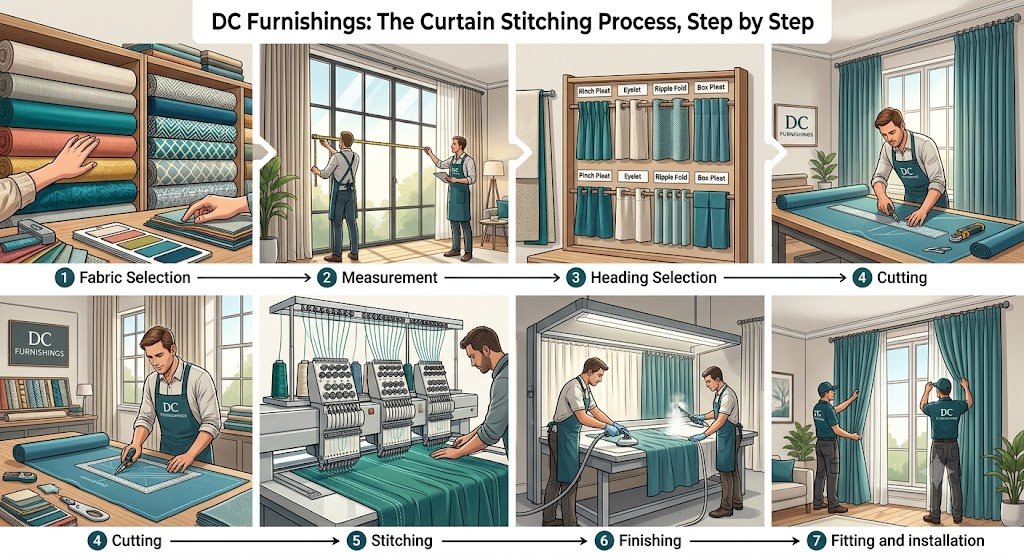
- Fabric Selection comes first, and it shapes every decision after its a heavy velvet and a lightweight sheer need completely different handling throughout the rest of the process.
- Measurement follows immediately, since every subsequent step from how much fabric to cut to which heading style will work depends on accurate window, track, and drop measurements taken at this stage.
- Heading selection determines how the curtain will actually hang and move, and needs to be decided before cutting, since different headings require different amounts of fabric and different construction techniques.
- Cutting the fabric to size, accounting for fullness, hems, and heading allowance, is where precision starts to matter in a very literal, measurable sense a small error here compounds through every later step.
- Stitching the panel together hems, side seams, heading construction, and lining attachment if used is the most labour intensive stage, and where fabric specific handling (discussed further below) really comes into play.
- Finishing covers the final detailing: pressing, trimming loose threads, and ensuring the heading sits correctly and consistently across the full width of the curtain.
- Fitting and installation is the last step, where the finished curtain is hung on its track or rod and adjusted to hang correctly this is also where measurement accuracy from earlier in the process either pays off or reveals itself as a problem.
Each of these steps depends on the ones before it, which is exactly why skipping or rushing any single stage tends to show up in the finished product.
The Importance of Accurate Measurements
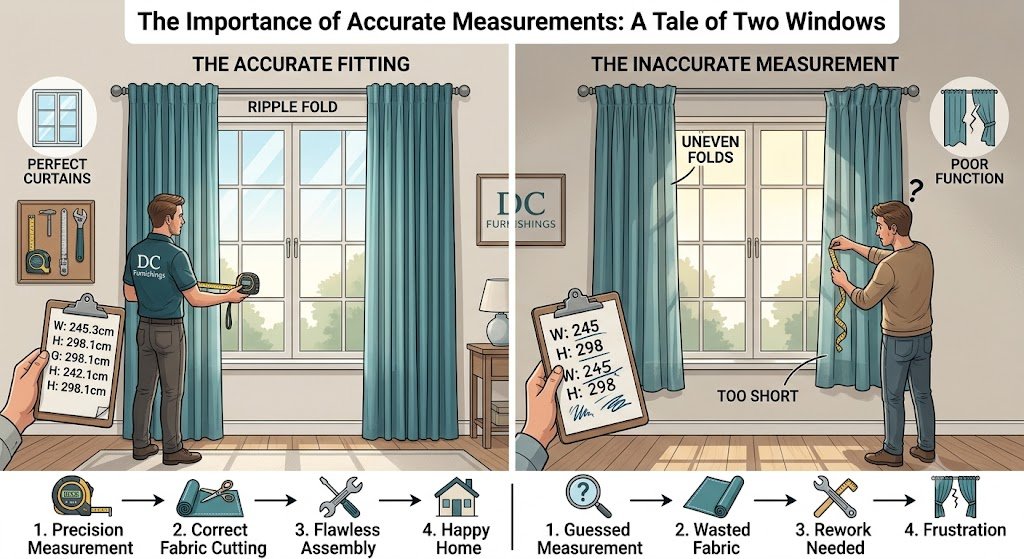
This is arguably the single most consequential part of the entire process. Getting a curtain to hang and drape correctly depends on measuring and accounting for:
- Window width and height
- Track or rod width, including any overlap or return
- Curtain drop the finished length from heading to hem
- Fabric fullness how much extra fabric width is used relative to the track width to create proper folds
- Hem allowance and heading allowance the extra fabric needed at top and bottom for finishing
- Floor clearance whether the curtain should just clear the floor, puddle slightly, or sit at sill length
Across the curtain making industry, a fullness ratio of around 1.5x to 2x the track width is widely considered standard for a well draped curtain, with fuller ratios used for a more luxurious, heavier folded look. Get the fullness wrong, and even a beautifully stitched curtain will look flat and stretched rather than soft and full.
Our detailed guide on how to measure curtains correctly walks through each of these measurements step by step, a useful reference before any custom curtain order.
Choosing the Right Curtain Stitching Style
Heading style affects appearance, how the curtain moves, and which track or rod it needs. Here’s how the most common options compare:
Eyelet Metal rings sewn directly into the top of the curtain, allowing it to hang in soft, even folds directly from a rod. Works well in casual to contemporary interiors and requires a rod rather than a track.
Pinch pleat Fabric gathered into pinched folds at the top, giving a structured, tailored look. Suits both classic and contemporary interiors and typically uses hooks on a track or rod.
Pencil pleat Tightly gathered folds forming a dense, pencil like row along the top. Offers a fuller, traditional look and works with either a track or rod.
S Fold / Wave A modern heading style creating smooth, continuous S shaped waves across the width of the curtain. Requires a specific wave track system and suits sleek, contemporary interiors particularly well.
Back loop Fabric loops sewn to the back of the curtain, hiding the heading detail from the front for a clean, minimal look. Requires a rod that fits through the loops.
Hook style A more traditional heading using hooks inserted into curtain tape, offering flexibility across various track types.
American pleat A structured triple pleat style creating a tailored, formal appearance, generally paired with a track or rod suited to heavier folds.
DC Furnishings offers curtain stitching across several of these styles, including eyelet, American pleats, back loops, and hook style headings so the right choice really does come down to matching the heading to your room’s interior style and your existing (or planned) track/rod setup. For a broader look at how curtain styles vary beyond heading choice, see our guide on different types of curtains.
Fabric Behavior and Why It Changes the Stitching Approach
Stitching isn’t independent of the fabric being used in fact, the fabric often dictates the entire construction approach.
Curtain Stitching For Sheer Fabrics
It needs much gentler handling than heavier fabrics, since their lightweight, loose weave is more prone to snagging or puckering under standard stitching tension.
Curtain Stitching For Velvet and linen drape
They are very different, velvet’s weight and pile create a fuller, heavier fold, while linen falls more crisply and needs different fullness allowances to look right.
Curtain Stitching For Blackout lined curtains
It requires specific construction, since the lining needs to be properly integrated with the outer fabric without adding unwanted stiffness or bulk at the seams.
Fabric Weight Affects
The hardware choice heavier fabrics need more robust tracks, rods, and brackets capable of supporting the additional weight over time.
Natural fabrics may need a shrinkage allowance
It built into the cutting stage. Cotton in particular is well documented to shrink under certain washing and finishing conditions CottonWorks (Cotton Incorporated) notes that shrinkage in cotton fabrics is influenced by fiber type, construction, and finishing processes, which is exactly why accounting for it during stitching (rather than after the curtain is hung) avoids an uneven or shortened drop later on.
Why Choose Custom Curtain Stitching?
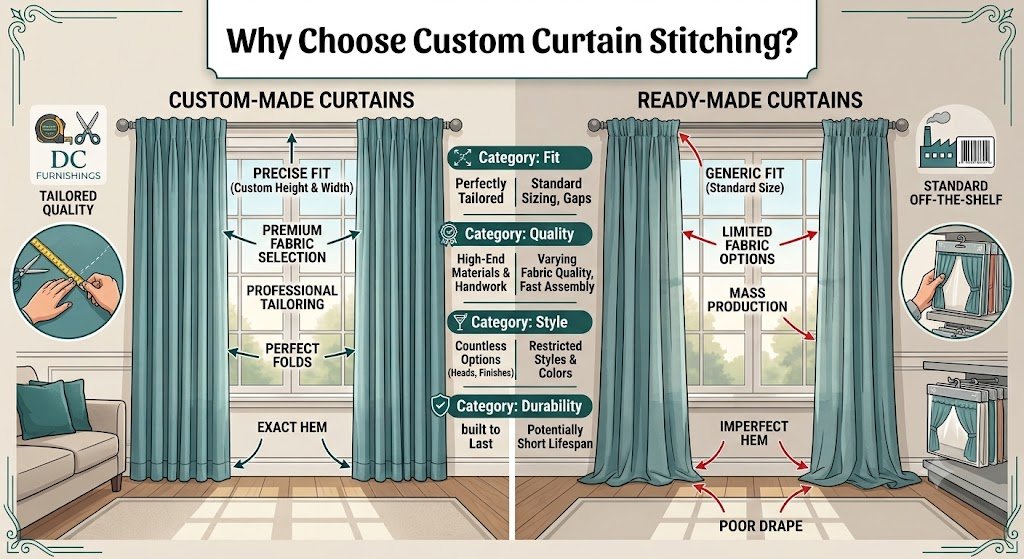
Custom Made Curtains
Custom made curtains are built entirely around your window, not the other way around. It offer precise measurements tailored to your exact window and track, a far wider range of fabric and heading choices, better handling of unusual or oversized windows, and more control over the final finishing details.
Fit — Every measurement is taken specifically for your window’s height and width, giving you a precise, tailored fit with no gaps or awkward overhang.
Quality — Custom stitching uses premium fabric selection and professional tailoring, with genuine handwork going into each panel rather than a rushed, generic assembly process.
Style — With custom stitching, you get countless options for heading styles and finishes, letting the curtain match your interior exactly instead of settling for whatever’s available.
Durability — Because custom curtains are built to last, with proper hems, exact folds, and quality construction throughout, they tend to hold their shape and finish far longer than an off-the-shelf option.
The result is a curtain with a precise fit, perfect folds, and an exact hem, the small details that make a window treatment look intentional rather than just “installed.”
Ready Made Curtains
Ready made curtains offer convenience, but that convenience comes with real trade offs. by comparison, are faster to acquire and usually more affordable but come with limited sizing and a narrower range of heading and fabric options.
Fit — Ready made curtains use a generic, standard sizing, which often leaves gaps at the sides or an awkward length that doesn’t quite suit your specific window.
Quality — Since these are mass-produced, fabric quality can vary from batch to batch, with faster assembly prioritized over the level of detail that goes into a custom piece.
Style — Off-the shelf options come with a more limited fabric and design range, restricting your choice of style and colour to whatever’s currently in stock.
Durability — With mass production comes a potentially shorter lifespan, along with common issues like imperfect hems and poor drape that show up more quickly with regular use.
For homeowners who need a quick, budget friendly solution and have a standard sized window, ready made curtains can still do the job. But for a genuinely tailored fit, a lasting finish, and a style that actually matches your space, custom made curtains remain the stronger long term choice.
With decades of experience in home furnishing, DC Furnishings approaches curtain stitching as more than simply sewing fabric the fabric, measurements, heading style, fullness, and final installation all influence how the finished curtain looks and performs. For homeowners weighing whether custom is worth the investment, our guide on the benefits of custom curtains goes deeper into this comparison.
Choosing Curtain Stitching for Different Rooms
Room use should directly shape fabric choice, heading style, curtain length, and overall finish. A formal living room might call for a fuller pencil pleat in a heavier fabric, while a bedroom might benefit from a blackout lined eyelet curtain for both style and function.
For Pune homes specifically, a few local factors are worth keeping in mind: apartment windows often have limited wall space around the frame, large balcony doors and floor to ceiling windows need heading styles suited to wide spans, strong sunlight through west facing windows may call for heavier or lined fabric, privacy needs vary significantly between ground floor and higher floor apartments, and AC heavy rooms often benefit from fuller, better insulating fabric choices.
Our guide on how to choose curtains for your living room covers this room by room thinking in more detail.
Best Curtain Stitching In Pune – DC Furnishings
When it comes to curtain stitching in Pune, DC Furnishings stands out as the go to choice for homeowners and businesses looking for a perfect, tailored fit. With an extensive range of customization options, fabric selection and pleat styles to lining, borders, and hardware, every curtain is designed to match the exact aesthetic and functional needs of the space.
What truly sets DC Furnishings apart is the seamless end to end service: from precise on site measurements to expert stitching and professional installation, the entire process is handled with care and craftsmanship. Be it classic pinch pleat drapes for a living room or sheer, minimalist curtains for a modern office, DC Furnishings in Pune combines skilled tailoring with timely delivery, making it the trusted name for custom curtain solutions that blend style, quality, and functionality.
Popular Curtain Stitching Styles for Modern Homes
S Fold and simplified pleat styles have been trending strongly in modern Pune interiors, valued for their clean, minimal appearance and smooth, wave like movement. For a broader look at where curtain design is heading, our guide on latest curtain design trends covers current heading styles and modern interior pairings in more depth.
Frequently Asked Questions
What is the difference between custom and ready made curtains?
Custom curtains are stitched to your exact window and track measurements with your choice of fabric and heading, while ready made curtains come in standard sizes and a more limited range of styles.
Which curtain heading style is best for modern homes?
S Fold and eyelet headings tend to suit modern, minimal interiors well, thanks to their clean lines and smooth movement.
How much fabric is needed for a full, well draped curtain?
A fullness ratio of roughly 1.5x to 2x the track width is generally considered standard, with fuller ratios used for a more luxurious, heavily folded look.
Do heavier fabrics need different stitching?
Yes heavier fabrics like velvet require different fullness allowances, hemming techniques, and often sturdier hardware to support their weight over time.
How long does custom curtain stitching take?
Turnaround time varies depending on fabric availability, heading complexity, and order volume, but it’s generally longer than picking up a ready made curtain, given the additional measurement and construction steps involved.
Can old curtains be re stitched into a new heading style?
In many cases, yes, provided there’s enough fabric width and length remaining to accommodate the new heading’s fullness and allowance requirements.
Final Thoughts
The difference between an average curtain and a beautifully finished one rarely comes down to the fabric alone it’s the measurement accuracy, heading choice, and stitching quality behind it that make a curtain hang, move, and last the way it should.
Looking for custom curtain stitching for your home? DC Furnishings helps you get the fit, fabric, and finish right from the very first measurement.
LAXMI ROAD – Kunte Chowk, 693, Laxmi Rd, Bhatancha Bol, Narayan Peth, Pune, Maharashtra 411030 | Contact – 76207 54159
NIBM ROAD – Shop No 4, Kundan The Peak, NIBM Rd, Mohammed Wadi, Pune, Maharashtra 411048 | Contact – 09970366316
Contact us to discuss your curtain Stitching requirements, or explore our guide on top curtain styles for 2025 for more inspiration.